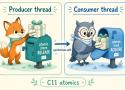
Still need to understand atomics and memory barrier? This is a neat primer.



When more concurrency might not help. Illustration with the case of database queries.

Sounds obvious to me, but I guess it's worth repeating. It illustrates well the type of issues you still have to deal with in multi-threaded Rust.

This is an excellent exercise to understand a language and its ecosystem better. This time it is about Rust.

Interesting piece which challenges the shared-memory vs. message-passing dichotomy. It message passing indeed gets rid of data races but nothing more. Of course this is nice already, but that doesn't mean you can't have the other families of concurrency bugs creeping in.
A good reminder that on modern hardware read-write locks are rarely the solution despite the documentation claims.
More interesting design ideas in uv. Didn't know about the dashmap crate they're using here it looks like a nice one too.

Very Rust focused, still it's an interesting debate. It gives a good overview of the different types of lock behaviors in case of failures. It's very much advocating for the poisoning approach which is indeed an interesting one (coming with its own tradeoffs of course).
If you're dealing with multithreading you should not turn to mutexes by default indeed. Consider higher level primitives and patterns first.

Does a nice job explaining how the scheduling can be investigated from outside the kernel. It is a good introduction on the topic.
Early days but this looks like interesting tooling to inspect and debug programs using Rust channels.
A few ideas to dig deeper into for better multi threaded throughput.

Its use cases are indeed limited. It's a success for network IO. For everything else, the free threading might be the path forward once it stabilizes.
This can be useful indeed to explore concurrency issues. It requires some work though.
This is an interesting and deeply buried optimization for the GNU C++ STL implementation. I didn't expect anything like this.
This is a nice summary of the Send and Sync traits semantic in Rust.
Since atomics are really a hard topic, this article is welcome. It does a good job explaining what memory ordering does. It helps to debunk some common misconceptions.
A good example of how you can get bitten by cache coherency algorithms in the CPU.

Nice deep dive into a bug lurking inside a lock implementation.

Or why I'm still on the fence regarding async/await. It's rarely the panacea we pretend it to be.