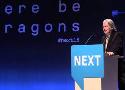
Very powerful talk from Bruce Sterling about design and the startup culture. The most impactful part starts somewhere in the middle (where the URL leads you).


Long but excellent opinion piece about everything which is wrong with the current AI-mania.

This debate around licensing, politics and making our FOSS efforts sustainable need to happen. It looks like for now to some people the path forward is defensive licensing? I wish at least we'd first attempt to have more strong copyleft use...
This is indeed the best way to handle your open source dependencies. I got concerns about the ability to sell that to management though because of the extra steps. It's also probably why you want to have an OSPO in your company, it's a good way to lower the barrier for developers to contribute this way.

I'm a bit on the fence regarding this article. That being said there's something I like about it: it's not always purely about money. It's also a good reminder that if the reward is in monetary form it's almost impossible to not somehow alter team dynamics with it.

The business model is still not here... There won't be an LLM company making money, it'll be bundled with something else.
Those companies still don't make any economic sense... It's really just a ploy for fake growth.
I recognize myself quite a bit in this opinion piece. It does a good job going through most of the ethical and practical reasons why you don't need LLMs to develop and why you likely don't want to.
There's clearly something tempting about a web index somehow separated from Google. It always felt like a natural monopoly and so a type of public service.
Now that push arrives a tad late so the impacts are unclear. Overall I still think this would be a net positive if there are more web search companies built onto such an index.
I don't think I'm ready to give up just yet... Still, I recognise myself so much in this piece it feels like I could have written it (alas I don't write as well).
A long but important report in my opinion. Reading the executive summary is a must. This gives a good overview of the AI industrial complex and the type of society it's leading us into. The report algo gives a political agenda to put us on a better path.

It definitely has a point. The code output isn't really what matters. It is necessary at the end, but without the whole process it's worthless and don't empower anyone... It embodies many risks instead. I think my preferred quote in this article is this:
"We are teaching people that they are not worth to have decent, well-made things."

That's a good overview of the energy demand, it doesn't account for all the resources needed of course. Now of course like most articles and studies on the topic, it's very inaccurate because of the opacity from the major providers in that space. The only thing we know is that the numbers here are likely conservative and the real impact higher. Mass use of those models inferences is already becoming a problem, and it's bound to get worse.

It looks like desperate times for the venture capitalists behind the AI bubble...

Looks like the productivity gain promises are still mostly hypothetical. Except on specific limited tasks of course but that doesn't cover for a whole job. Also, when there is a gain it's apparently not the workers who benefit from them.

This is a question which I have been pondering for a while... what will be left when the generative AI bursts. And indeed it won't be the models as they won't age well. The conclusion of this article got a chill running down my spine. It's indeed likely that the conclusion will be infrastructure for a bigger surveillance apparatus.
Don't confuse scenarios for predictions... Big climate improvements due to AI tomorrow after accepting lots of emissions today is just a belief. There's nothing to back up it would really happen.

I hope people using Grok enjoy their queries... Because they come with direct environmental and health consequences.
The wonderful world of personalised pricing in the age of widespread surveillance... Also becoming personalised wage fixing in the case of gig workers. Shameful.

Good perspective on how the generative AI space evolved in 2024. There are good news and more concerning ones in there. We'll see what 2025 brings.